How to choose summer yarns like a materials scientist
When knitters search for the best summer yarn, the recommendations are almost always the same:
"Use cotton."
"Linen is amazing."
"Silk is luxurious."
While these recommendations aren't wrong, they rarely explain why certain fibers perform well in warm weather. As a materials engineer, that's the question I find most interesting.
Engineers don't choose materials based on popularity, they choose them based on performance. Every material has a unique combination of mechanical, thermal, and chemical properties that determine whether it's suitable for a specific application.
Choosing yarn is no different.
Instead of asking "What's the best summer yarn?", we should ask:
What properties does a summer garment actually need?
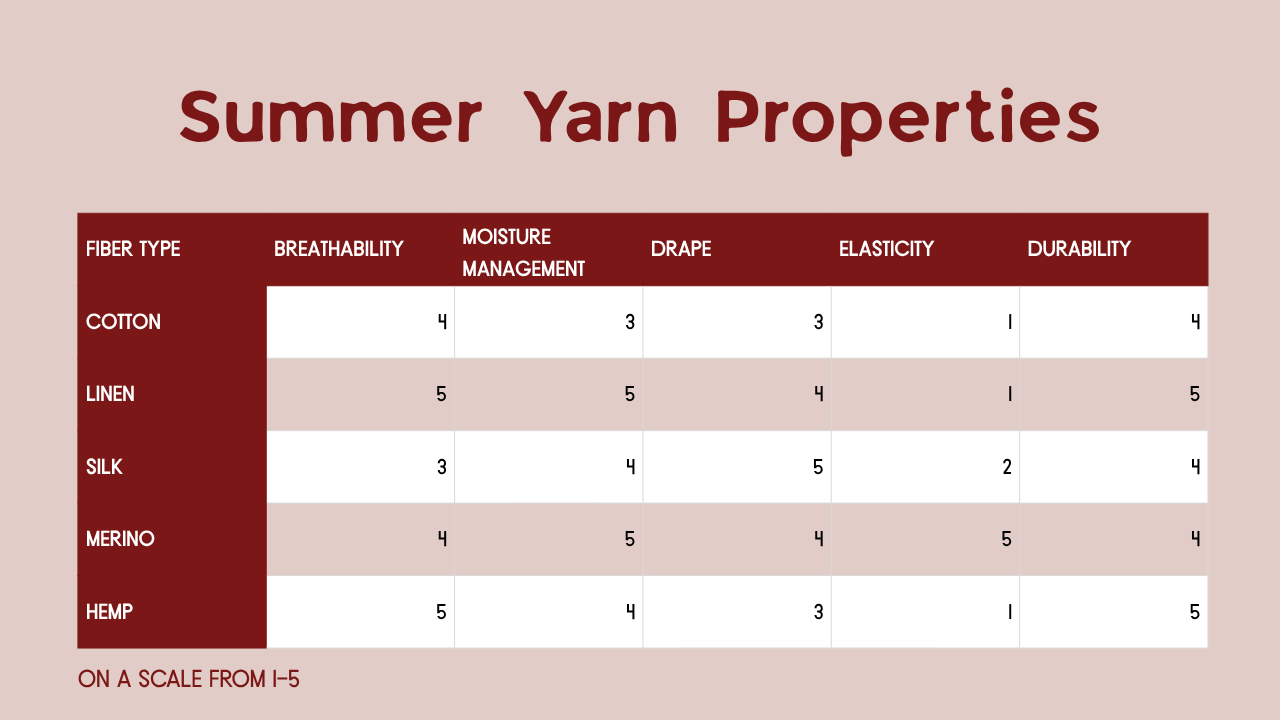
When designing clothing for warm weather, there are several important material properties to consider.
Breathability refers to how easily air can move through a fabric. While fiber type plays a role, the fabric structure is equally important. A loosely knitted garment allows much more airflow than a dense fabric, regardless of the fiber used.
Moisture management: Our bodies constantly release moisture through perspiration. Some fibers absorb this moisture, while others transport it more effectively through the fabric. Good moisture management helps garments remain comfortable in warm conditions.
Thermal conductivity describes how quickly heat moves through a material. Fibers with higher thermal conductivity often feel cooler against the skin because they transfer heat away from your body more efficiently.
Elasticity: Summer garments are often lightweight and drapey, but they still need to maintain their shape. Fibers differ greatly in their natural elasticity, influencing how well a garment recovers after stretching.
Drape: Some fibers create structured garments, while others produce fabrics that flow naturally around the body. Drape influences both comfort and appearance.
Cotton: The Familiar Choice
Cotton is one of the most popular fibers for summer knitting, and for good reason.
Cotton fibers consist almost entirely of cellulose, a natural polymer composed of repeating glucose molecules. Along these polymer chains are numerous hydroxyl (-OH) groups that readily form hydrogen bonds with water molecules.
This chemical structure makes cotton highly absorbent.
Cotton can absorb approximately 8 - 10% of its weight in moisture before it even begins to feel damp. This contributes to its comfortable feel during everyday wear.
However, high absorbency also has disadvantages.
Once cotton absorbs moisture, it tends to retain it, particularly in humid environments. A cotton garment may therefore become heavier and require longer to dry compared with fibers that transport moisture more efficiently.
Cotton also has relatively low elasticity because cellulose chains lack the highly elastic molecular structure found in protein fibers such as wool. Over time, knitted cotton garments may stretch, especially if they are heavy or loosely constructed.
Advantages
Comfortable
Breathable
Easy to wash
Affordable
Limitations
Low elasticity
Can stretch over time
Holds moisture relatively well
Linen: One of Nature's Highest-Performing Summer Fibers
If I had to choose a single fiber for summer knitting, linen would be one of my strongest recommendations.
Linen is produced from the stem of the flax plant and belongs to a class of fibers known as bast fibers. Unlike cotton, which grows around seeds, bast fibers develop within the plant stem, resulting in long, highly aligned cellulose fibers.
This highly ordered structure gives linen exceptional tensile strength and durability.
Linen also possesses relatively high thermal conductivity compared with many other natural fibers. This is one reason linen often feels noticeably cool when first touched.
Its moisture management is equally impressive. Linen readily absorbs moisture while also allowing it to evaporate efficiently, helping garments remain comfortable in warm weather.
Many knitters initially dislike working with linen because it feels stiff and lacks elasticity. This stiffness arises from the rigidity of the cellulose-rich fibers rather than poor quality.
Fortunately, linen changes dramatically with use.
Repeated washing gradually softens the fibers, producing the relaxed feel that makes well-worn linen garments so popular.
Advantages
Excellent breathability
Outstanding durability
Cool hand feel
Softens with age
Limitations
Stiff while knitting
Limited elasticity
Wrinkles easily
Silk: Strong, Lightweight, and Beautiful
Silk is often associated with luxury, but its material properties are equally remarkable.
Unlike cotton and linen, silk is a protein fiber, composed primarily of fibroin. Fibroin molecules are highly aligned, creating an exceptionally strong fiber relative to its weight.
Silk is valued for its smooth surface, beautiful drape, and natural luster.
Because the fibers are smooth, fabrics made from silk tend to flow gracefully and reflect light differently from cellulose fibers.
However, silk is not necessarily the coolest summer fiber.
Pure silk lacks the crisp structure of linen and has limited elasticity. For this reason, many yarn manufacturers blend silk with linen, cotton, or wool to balance drape, softness, and stability.
Wool: Yes, Even in Summer
Including wool in a summer fiber discussion often surprises people.
Yet fine merino wool is widely used in outdoor clothing, hiking apparel, and performance base layers.
The reason lies in its moisture management.
Wool consists of keratin, a structural protein capable of absorbing up to approximately 30% of its own weight in water vapor before feeling wet.
Unlike cellulose fibers, wool helps regulate the microclimate around the skin by buffering changes in humidity. This contributes to the excellent temperature-regulating properties that make merino comfortable across a wide range of conditions.
Of course, yarn weight still matters.
A lightweight fingering-weight merino top behaves very differently from a bulky wool sweater.
Hemp: Linen's Close Relative
Hemp is another bast fiber with many similarities to linen.
It is exceptionally durable, breathable, and becomes softer with repeated washing.
Because hemp fibers are long and strong, garments maintain their integrity for many years.
Although less common than linen in hand knitting, hemp is an excellent option for knitters seeking natural fibers with outstanding longevity.
Regenerated Cellulose Fibers: Lyocell, TENCEL™, and Bamboo Viscose
Regenerated cellulose fibers are often misunderstood.
Although bamboo viscose, lyocell, and modal originate from different plant sources, the manufacturing process transforms the original cellulose into a regenerated fiber.
This means that the production method often influences the final properties more than the original plant itself.
These fibers generally offer:
Excellent drape
Soft hand feel
Good moisture management
Smooth surfaces
For knitters, they are particularly attractive when blended with fibers such as linen or cotton.
Why Fiber Blends Often Perform Better
One of the biggest lessons from materials engineering is that no single material excels at every property.
The same applies to yarn.
A cotton-linen blend combines cotton's softness with linen's cooling properties.
Linen-silk blends balance crispness with beautiful drape.
Merino-silk blends combine elasticity with luxurious softness.
Rather than searching for the "perfect" fiber, manufacturers often combine fibers to create yarns with optimized performance.
Final Thoughts
There is no universally "best" summer yarn.
Every fiber represents a balance of trade-offs.
If you want crisp, cool garments, linen is difficult to beat.
If comfort and affordability are your priorities, cotton remains an excellent choice.
If you love elegant drape, silk blends may be ideal.
And if you're looking for a garment that performs across changing temperatures, lightweight merino deserves far more attention than it usually receives.
As a materials engineer, I don't think in terms of good or bad fibers.
I think in terms of properties.
Because choosing the right yarn isn't about following trends - it's about selecting the right material for the job.